Profile
Profile
Profile
Profile
-
Graphic Design
Graphic Design
Graphic Design
Graphic Design
-
UI & UX
UI & UX
UI & UX
UI & UX
-
Musings
Musings
Musings
Musings
Contact
Contact
Contact
Contact


---- ETHNOGRAPHY ----
Polaris Project Overview
+ Introduction
Visitors and persons new to the ever growing UC San Diego campus often find themselves lost among the sprawl of buildings. The available campus directories are few and difficult to use. The Polaris Project was an exercise in the application of user centered contextual design aimed at UCSD directories. A team of 8 members gathered detailed information on how a variety of user groups (students, visitors, communters, vendors etc) used the directories at UC San Diego. The data was analyzed and the team drew up several work flow models to describe user needs and point of view. Using the data the team developed new design solutions to user problems.
+ Method
The team collected user data through contextual interviews. By working with the user as they interacted with the directory, the team hoped to gather clear and useful data about how people use the maps, what they liked about them, and the problems that occurred in the process. The team interviewed eleven users of varying ages and experiences with UCSD. Some were students from different colleges, some were community members and vendors, and one woman was on campus to perform an audit for a business company. The interviewer and user either approached a directory together on a retrospective account or the interviewer approached someone in the middle of using the directory. Informed conset was obtained for each user. In addition to contextual interviews the team also investigated other directories located in malls and hospitals.
+ Data
After gathering the information the team met for several interpretation sessions and created cultural, physical, sequence, flow, and artifact models of the data. These models outlined key user needs and allowed the team to see how users interact with maps to navigate.
Notable problems:
- Directories: few and far between directory locations, poor visibility (especially at night), placement and orientation force the user to make large mental rotations to match their surroundings
- Map: scope of the map is too small, map landmarks are abstract, legend is difficult to use
- User: has no way to store route information other than in one's mind, need different types of information (bathrooms, classrooms, transportation areas etc)
+ Resulting Design
Based on the user data the team developed solutions to address the main issues. Various prototype sketches of new directories were proposed. The team decided on the best features to include in a paper prototype which was created and tested with new users.
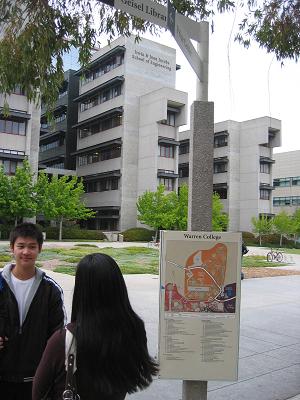
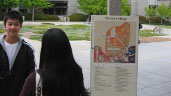

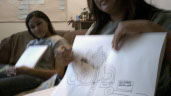

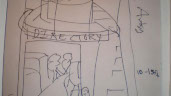
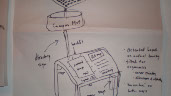


Our team conducted contexual interviews at directory sites.
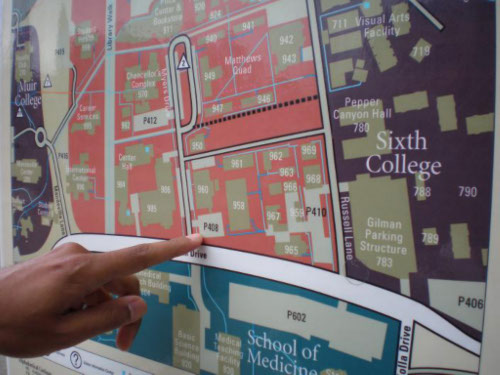
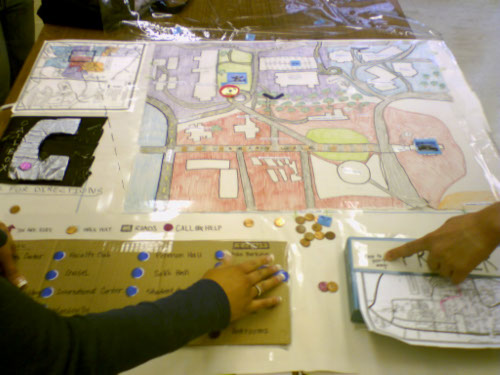
Users often traced their route on the directory with a finger. Many directories lacked a "You are Here" indicator.
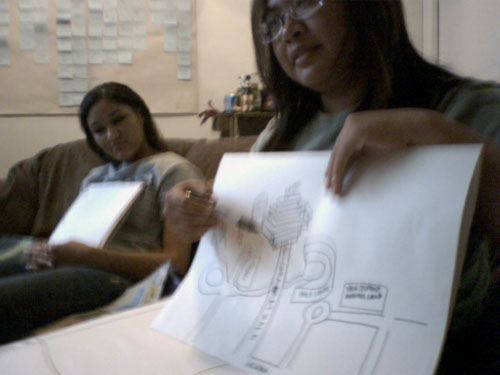
One of the team interpretation sessions, here Aiza Abelon is discusisng how landmarks could be represented on maps.
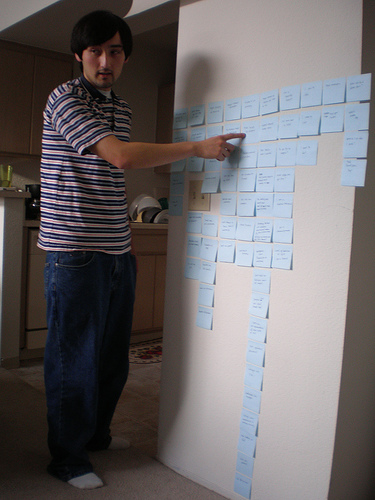
In the process of interpreting the data our team built an affinity diagram to organize user needs. David Yoshida helps organize the diagram.
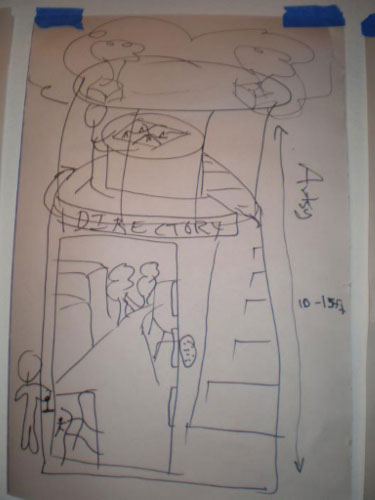
A sketch illustrating some ideas for a new directory: tower like structure allows users a similar bird's eye view as the map, a large screen provides a video fly through of the route.
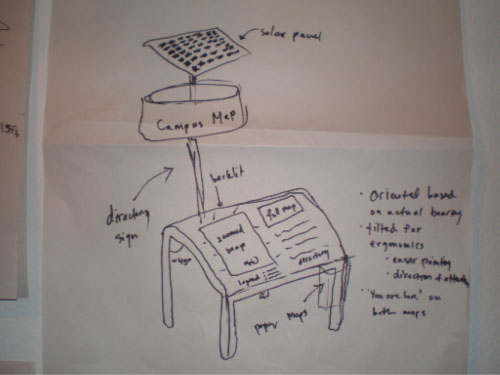
A sketch of a prototype directory which uses a table design, and has a place for paper maps which visitors can take with them.
The team prototype design featuring: real time help via a phone, a printer for custom maps with highlighted routes, lighted screen and two views - one local and one of the campus to provide context.
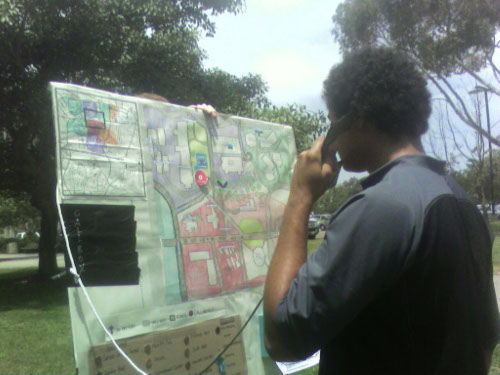
Testing the prototype design with a new user.
< PREV
NEXT >
San Diego Bus System
+ Introduction
The city buses that serve the La Jolla vicinity must cater to a large population of students which rely on public transport to get to class on time, go grocery shopping and stay on top of busy schedules. However the buses serving the area are often off schedule (early and late), the bus stops are unhelpful to new visitors and there is a general unsatisfactory user experience. A team of 3 members collaborated to collect user data and propose improvements to the system.
+ Method
The team conducted several interviews with riders at the local bus stops on the UCSD campus and also was able to interview one of the bus drivers. There was a variety of users including transfer students, staff/researchers and, students living on campus. Users were asked about commuting routines, motivation for using the bus, their schedules, past experiences with the system etc. In addition to interviews the team examined bus interiors and researched bus stop implementations in other cities.
+ Data
The majority of users commute to UCSD and utilize the bus system for getting to and from work/classes. The buses are often late, worse is when they come early causing the user to wait the maximum interval between buses. Users got schedule information from a variety of sources but such information was often invalidated by the bus being off schedule.
Notable Problems:
- Bus Stops: no way of knowing if a bus was just missed, or time till the next bus arrives, signs just have route numbers which are mostly useless to new users, overall a general lack of information
- Bus Interior: pay station in the bus - forces users to stand while paying, must have exact change, bus needs to wait while user pays, or user must try to balance as the bus moves forward, bus driver announcements are often unheard due to background noise or cellphone use
- Users: Not all stops are listed online or in the route map pamphlets, need for buses to be on schedule or able to accomodate large capacity in the mornings since many students commute to school
+ Proposed Improvements
Based on the user interviews and research of other bus systems the team proposed a number of changes including a SMS texting system which allows users to recieve updates on bus times, adding bus route area maps to bus stops and improved maps.

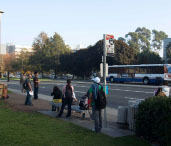
Typical bus stop scene: Lack of schedule information and useful navigational aids, only the route numbers on the sign
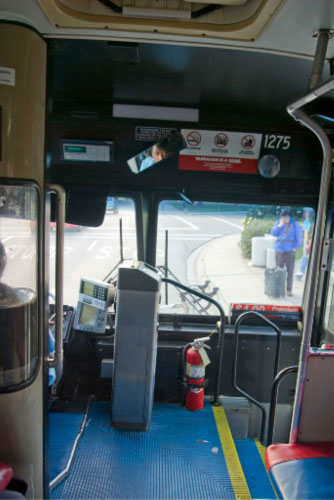
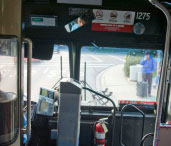
Bus interior: food and drink signs are often ignored, paying passengers must balance at the front of a moving bus
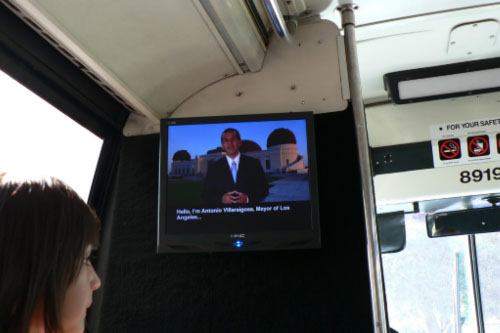
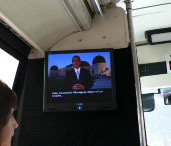
Some buses have screens installed, but they are more often used for advertising than as a navigation display.
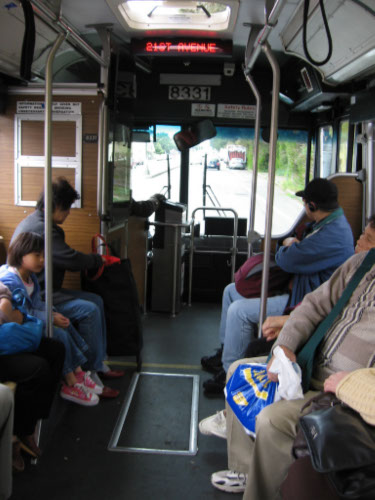
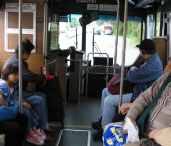
This bus has a small display announcing the upcoming street. Also passengers often need to keep personal belongings close at hand.
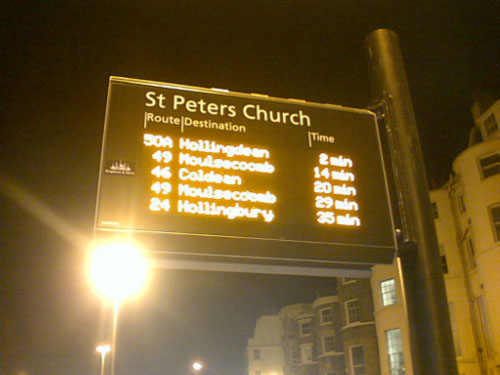
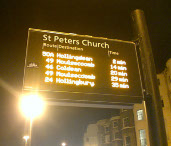
In Southern England an electronic bulletin displays arrival times and destinations for several bus routes.
< PREV
NEXT >
Polaris Project
San Diego Bus System




